
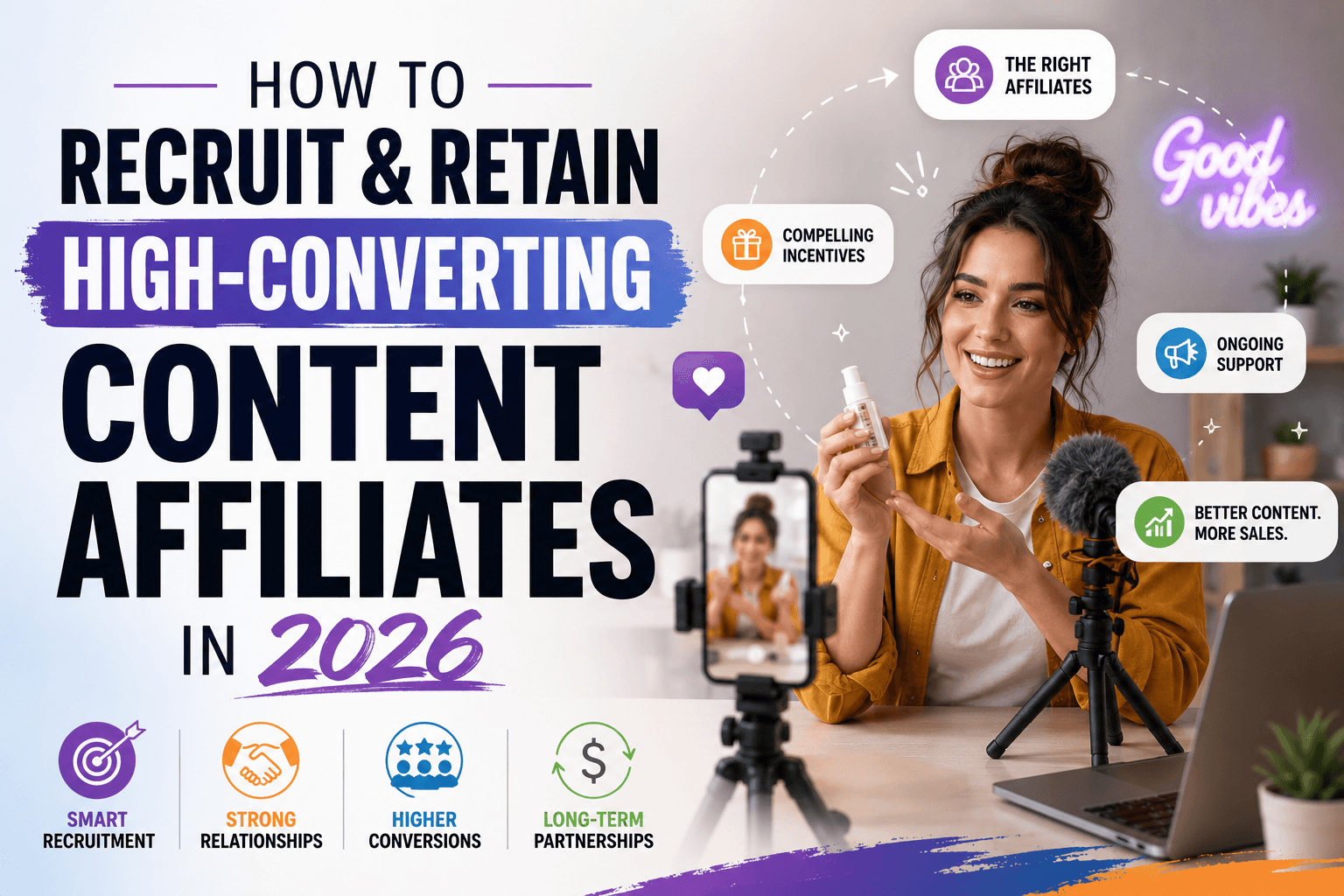
How to Recruit and Retain High-Converting Content Affiliates in 2026
By Hubmikado Team
For many brands, launching an affiliate program is the easy part.
The difficult part is getting the right affiliates to actually promote the products.
You can have an attractive commission rate, a sophisticated tracking platform, a polished affiliate portal, and a library of marketing assets—and still struggle to generate meaningful affiliate revenue.
Why?
Because affiliate marketing is ultimately a people and partnership business.
The best content creators aren't sitting around waiting for another generic affiliate invitation. They already have dozens of brands competing for their attention. They receive emails every week asking them to "join our program," "earn commission," or "partner with our brand."
If your outreach looks exactly like everyone else's, it is easy to ignore.
And even when you successfully recruit a creator, getting their first sale isn't the end goal.
You want them to become a long-term, high-converting partner who repeatedly features your products, creates original content, and prioritizes your brand over competing offers.
That requires a different approach to recruitment and retention.
This guide explains how brands can recruit and retain high-converting content affiliates in 2026—from identifying the right creators and improving outreach to creating custom incentives, providing useful assets, and building relationships that last.
Why Content Affiliates Matter More Than Ever
Consumers are increasingly influenced by people they trust.
A traditional advertisement tells a customer why they should buy something.
A creator can show them.
They can demonstrate the product, explain how it works, compare alternatives, answer questions, share personal experiences, and place the product into a real-world context.
That's especially valuable for products where customers need education or reassurance before purchasing.
Examples include:
- Beauty
- Fashion
- Fitness
- Home products
- Technology
- Food and beverage
- Parenting
- Travel
- Lifestyle products
- Specialty products
Content affiliates can function as both media partners and performance partners.
They create the content themselves while being compensated based on measurable results.
But not every creator is a good affiliate.
A large audience doesn't automatically translate into conversions.
In many cases, a smaller creator with a highly relevant and engaged audience can outperform a much larger account.
The goal isn't to recruit the biggest creators.
It's to recruit the creators most capable of influencing your target customer.
1. Stop Treating Affiliate Recruitment Like Mass Email
One of the biggest reasons affiliate recruitment fails is that brands approach it like traditional outbound sales.
They build a large spreadsheet.
They collect email addresses.
Then they send the same message to everyone.
Something like:
"Hi, we'd love to invite you to join our affiliate program. You can earn up to 10% commission by promoting our products."
Technically, there is nothing wrong with the message.
But there is nothing particularly compelling about it either.
The creator has probably received similar messages many times.
Your first goal isn't to explain your affiliate software.
Your first goal is to answer:
"Why would this partnership make sense for this particular creator?"
Why Generic Cold Outreach Doesn't Work
Creators are protective of their audiences.
Their credibility is one of their most valuable assets.
If a creator promotes every random product that contacts them, their audience eventually stops trusting their recommendations.
That means they are constantly evaluating:
- Is this product relevant to my audience?
- Would I genuinely recommend it?
- Is the brand credible?
- Is the product worth talking about?
- Will the partnership be financially worthwhile?
- Will the brand actually support me?
- Can I create good content around it?
A generic affiliate invitation answers almost none of these questions.
What to Send Instead
Your outreach should demonstrate that you've actually looked at the creator's content.
Mention something specific.
For example:
- A recent video
- A product category they frequently discuss
- A recurring audience question
- A previous brand collaboration
- A content format they use particularly well
- A specific product that fits their audience
Instead of:
"We'd love you to promote our skincare range."
Try something closer to:
"Your recent videos around simplifying evening skincare routines stood out to us. We think our three-step routine would fit naturally into that type of content, particularly because it addresses the same problem your audience is already asking about."
The second message gives the creator a reason to pay attention.
2. Build a High-Quality Affiliate Prospect List
Recruitment starts before outreach.
If you're contacting the wrong creators, improving your email copy won't solve the problem.
Build your prospect list around audience relevance, not follower count.
Consider evaluating:
Audience Fit
Does the creator's audience resemble your target customer?
Content Fit
Does the creator naturally produce content where your product makes sense?
Engagement
Do people actually interact with the creator's content?
Content Quality
Can they create content that represents your brand well?
Commercial Experience
Have they successfully promoted products before?
Conversion Potential
Do they have evidence of influencing purchasing decisions?
Brand Alignment
Would you be comfortable having their content associated with your brand?
Consistency
Do they publish regularly?
A creator who produces excellent content once every six months may be less valuable than someone who consistently publishes relevant content every week.
Don't Ignore Micro and Mid-Tier Creators
One of the biggest recruitment mistakes is focusing exclusively on large influencers.
Creators with smaller audiences can be extremely valuable.
A micro-creator might have:
- A highly specialized audience
- Strong community trust
- High engagement
- Strong product relevance
- More flexibility around partnerships
Consider the difference between:
Creator A: 1 million followers, broad lifestyle content
and
Creator B: 35,000 followers, highly specialized content directly related to your product category.
Creator B may have far greater commercial relevance.
Don't evaluate creators solely on audience size.
Evaluate audience quality and purchase influence.
3. Create Different Outreach Strategies for Different Creator Types
Not every creator should receive the same offer.
Consider segmenting prospects into groups.
Emerging Creators
These creators may be early in their commercial journey.
They may respond well to:
- Product gifting
- Affiliate commissions
- Exclusive discount codes
- Early access
- Performance bonuses
- Opportunities to be featured by the brand
Established Creators
These creators may expect more structured commercial arrangements.
They may be interested in:
- Higher commissions
- Hybrid compensation
- Guaranteed content fees
- Performance bonuses
- Exclusive campaigns
- Product launches
High-Value Strategic Creators
These are creators with proven conversion ability or particularly valuable audiences.
They may justify:
- Custom contracts
- Hybrid deals
- Custom commission rates
- Exclusive products
- Long-term campaigns
- Dedicated account management
The more valuable the partner, the less appropriate a one-size-fits-all offer becomes.
4. Use Hybrid Deals to Attract Strong Creators
Some high-quality creators won't want to work exclusively on commission.
That's understandable.
Creating professional content requires time and resources.
A hybrid model can combine:
Fixed fee + affiliate commission
For example:
$500 content fee + 10% commission
The exact structure should depend on the creator, campaign, content requirements, and economics.
The advantage is that both parties have skin in the game.
The creator receives guaranteed compensation for their work.
The brand receives performance-based upside.
And the creator still has a financial reason to drive conversions.
When Hybrid Deals Make Sense
Hybrid compensation can be particularly useful when:
- You want professionally produced content.
- The creator has a strong track record.
- The content has value beyond immediate affiliate sales.
- You want usage rights for paid advertising.
- The creator is hesitant to work exclusively on commission.
- You are testing a potentially strategic partnership.
However, don't offer hybrid deals to everyone.
Reserve them for partners where the expected value justifies the investment.
5. Build Tiered Affiliate Incentives
A flat commission can become boring.
Creators need reasons to continue promoting your products.
Performance-based tiers can help.
For example:
Base: 10%
$2,500 monthly sales: 12%
$5,000 monthly sales: 14%
$10,000 monthly sales: 16%
These figures are illustrative. Your actual structure should be based on your margins and customer economics.
You can also create temporary campaign bonuses.
For example:
"Generate $5,000 in sales during our holiday campaign and receive an additional $500 bonus."
This gives creators a clear goal.
Instead of simply saying:
"Keep promoting us."
You're giving them something measurable to work toward.
6. Give Creators Exclusive Discount Codes
An exclusive discount code can be useful for both the creator and the brand.
For the creator, it gives them something tangible to offer their audience.
For the brand, it can provide an additional mechanism for tracking performance and identifying creator-driven purchases.
For example:
JESSICA10
is more memorable than a generic affiliate URL.
The best discount codes can become part of the creator's brand relationship with their audience.
However, be careful with excessive discounting.
If your business constantly relies on discounts, customers may learn to wait for promotions rather than purchasing at full price.
Your discount strategy should therefore fit your overall pricing and customer acquisition strategy.
7. Give High-Potential Affiliates Early Product Access
Product gifting shouldn't be viewed simply as free samples.
It can be a recruitment and retention strategy.
Creators need something worth talking about.
If you have:
- New products
- Limited editions
- Seasonal launches
- New colors
- Product improvements
- Exclusive bundles
consider giving selected affiliates early access.
You can create a simple structure:
Pre-launch → Creator access → Content creation → Public launch → Affiliate promotion
This gives creators an opportunity to publish content before or alongside the wider campaign.
It also makes the partnership feel more exclusive.
8. Make Your Affiliate Program Easy to Promote
A creator shouldn't have to spend an hour figuring out how to promote your product.
Provide the information they need.
Your affiliate resource center can include:
Product Information
- Key benefits
- Features
- Use cases
- FAQs
- Product comparisons
Creative Assets
- Product photos
- Lifestyle images
- Videos
- Graphics
- Logos
Promotional Information
- Current promotions
- Discount codes
- Campaign dates
- Best-selling products
- New releases
Content Ideas
Give creators angles rather than scripts.
For example:
- "Three reasons I switched to..."
- "What I wish I knew before buying..."
- "Best products for..."
- "I tested X for 30 days..."
- "X vs. Y: Which one is better?"
You want to make content creation easier without making creators sound like advertisements.
9. Don't Over-Control Creator Content
This is one of the most important principles in creator affiliate marketing.
You hired the creator because they understand their audience.
If you give them a 900-word script and require them to repeat every brand message exactly, the content may feel unnatural.
Instead, provide:
Mandatory facts + brand restrictions + creative freedom
For example:
Must Include
- Correct product name
- Approved product claims
- Affiliate disclosure
- Required discount code
Do Not Include
- Unsupported medical claims
- Competitor misinformation
- Unapproved guarantees
- Misleading pricing
Creator Freedom
- Storytelling format
- Visual style
- Personal experience
- Content structure
- Hook
- Presentation
The strongest creator partnerships preserve authenticity while protecting the brand.
10. Build a Communication Rhythm
Recruiting an affiliate is not enough.
You need to stay relevant.
If your only communication is:
"Here's your affiliate link."
the relationship will probably become inactive.
Create a predictable communication rhythm.
Monthly Affiliate Newsletter
A monthly newsletter can include:
- New products
- Best-performing products
- Upcoming campaigns
- New creative assets
- Seasonal promotions
- High-performing content examples
- Commission opportunities
- Affiliate success stories
Keep it useful.
Don't turn every email into a sales pitch.
Monthly Asset Drops
Instead of expecting affiliates to constantly request creative, proactively send new resources.
For example:
January: New-year campaign assets
February: Valentine's promotion
March: Spring product launch
April: New product education assets
And so on.
The exact schedule depends on your business, but the principle is simple:
Give affiliates fresh reasons to talk about you.
Product Gifting Calendar
You can also establish a predictable gifting strategy.
For example:
Quarter 1: New product
Quarter 2: Seasonal bestseller
Quarter 3: Product refresh
Quarter 4: Holiday bundle
Don't send products randomly.
Tie gifting to campaigns and content opportunities.
11. Build One-to-One Relationships With Your Best Affiliates
Your top affiliates shouldn't receive exactly the same communication as everyone else.
If a creator consistently generates strong revenue, invest more time in the relationship.
Ask them:
- Which products are performing best?
- What questions is their audience asking?
- What content formats work?
- What would make promotion easier?
- Which upcoming launches interest them?
- What type of offer would motivate their audience?
This information is incredibly valuable.
Your affiliates are close to the customer.
They can tell you what people are asking before that information appears in your analytics.
12. Turn Affiliates Into Product Feedback Partners
High-performing creators can provide more than sales.
They can become a feedback channel.
For example, they might tell you:
"My audience likes the product, but they're confused about how to use it."
That could indicate a product education problem.
Or:
"People keep asking whether you offer a smaller size."
That could reveal a product opportunity.
Or:
"The price is the biggest objection I hear."
That could inform your promotional strategy.
The best affiliate relationships create a feedback loop:
Brand → Creator → Audience → Creator → Brand
That is far more valuable than simply distributing affiliate links.
13. Identify and Reward Your Top Performers
Your affiliate program should continuously identify partners who deserve more investment.
Track metrics such as:
- Revenue
- Orders
- Conversion rate
- New customers
- Average order value
- Commission earned
- Repeat purchase rate
- Content performance
- Promotional frequency
Then segment partners into categories.
High Revenue + High Potential
Invest heavily.
High Engagement + Low Sales
Test better offers or products.
High Traffic + Low Conversion
Investigate audience fit or landing-page problems.
High Conversion + Low Traffic
Help them scale traffic.
Inactive but Relevant
Re-engage them with new products or incentives.
This prevents your team from treating every affiliate identically.
14. Create a Re-Engagement Strategy
Some affiliates won't respond to your first outreach.
That doesn't necessarily mean they're uninterested.
Timing matters.
A creator may have been busy, traveling, working on another campaign, or simply missed your message.
Build a follow-up sequence.
For example:
Follow-up 1: Additional reason the partnership fits
Follow-up 2: Introduce a product or promotion
Follow-up 3: Offer a sample or exclusive incentive
Follow-up 4: Close the loop politely
Don't send ten identical reminders.
Every follow-up should add something useful.
15. Avoid Paying for Vanity Metrics
A creator with impressive engagement numbers isn't automatically a strong affiliate.
Look beyond:
- Followers
- Likes
- Views
Try to understand:
- Click-through rate
- Conversion rate
- Customer quality
- Purchase intent
- Audience relevance
- Historical affiliate performance
- Repeat purchases
For affiliate marketing, the most important question is:
Can this creator influence profitable customer behavior?
That's more useful than asking:
How many followers do they have?
A Practical 90-Day Creator Affiliate Recruitment Strategy
If your affiliate program currently has very few active content partners, you can structure your first three months around a simple process.
Month 1: Build the Pipeline
Identify 100–200 relevant creators.
Score them based on:
- Audience fit
- Content quality
- Engagement
- Brand fit
- Commercial experience
Then prioritize the strongest prospects.
Month 2: Recruit and Activate
Begin personalized outreach.
Send product samples to selected creators.
Offer standard commissions to emerging partners.
Use hybrid or custom deals for high-value prospects when appropriate.
Give new partners:
- Tracking links
- Discount codes
- Product information
- Creative resources
- Content ideas
Then track activation.
Month 3: Optimize
Identify which creators are actually producing results.
Increase investment in high-potential partners.
Test:
- Higher commissions
- Performance bonuses
- Exclusive codes
- New products
- Hybrid campaigns
- Product gifting
- Exclusive bundles
At the end of 90 days, you should have a much clearer understanding of which creator profiles work best for your brand.
A Simple Content Affiliate Scorecard
Use a scorecard to avoid making decisions based purely on follower count.
| Factor | What to Evaluate |
|---|---|
| Audience Fit | Does their audience match your customer? |
| Content Fit | Can your product naturally appear in their content? |
| Engagement | Does the audience interact meaningfully? |
| Credibility | Does the creator appear trustworthy? |
| Content Quality | Can they produce strong content consistently? |
| Commercial Experience | Have they successfully promoted products? |
| Conversion Potential | Are they capable of driving purchases? |
| Brand Fit | Does their image align with your brand? |
| Growth Potential | Could the relationship become strategically valuable? |
You can assign each factor a score and prioritize the creators with the strongest overall potential.
The Biggest Shift: Stop Thinking About Affiliates as "Traffic Sources"
This mindset is holding many brands back.
Creators aren't simply another source of clicks.
They're distribution partners with audiences, credibility, content capabilities, and customer insight.
When you treat them like anonymous traffic sources, your relationship tends to become transactional:
Link → Click → Sale → Commission
When you treat them as partners, the relationship becomes:
Product → Story → Content → Audience → Trust → Sale → Feedback → Growth
The second model creates far more long-term value.
How to Retain Your Best Content Affiliates
Recruitment gets you into the game.
Retention determines whether the channel scales.
Your best affiliates should know:
- What is launching next
- Which products are performing
- Which campaigns are coming
- What incentives are available
- How much they can earn
- Who they can contact
- Where to find creative assets
They should also feel that the relationship is worth their time.
That doesn't always mean paying the highest commission.
Sometimes it means:
- Faster communication
- Early access
- Exclusive products
- Better creative support
- Flexible campaigns
- Recognition
- Performance bonuses
- Genuine relationship building
Creators remember which brands make their lives easier.
Final Thoughts: The Best Affiliate Programs Are Built on Relationships
The affiliate recruitment problem isn't simply a lack of emails.
It's a lack of relevant opportunities.
Creators don't need another generic affiliate link.
They need a reason to believe your product will be valuable to their audience—and a reason to believe the partnership will be worthwhile for them.
That means brands need to rethink the entire affiliate recruitment process.
Instead of:
Find creators → Send mass emails → Wait
Build a system:
Identify → Qualify → Personalize → Recruit → Incentivize → Equip → Communicate → Measure → Reward → Retain
That system creates a much more sustainable affiliate channel.
And in 2026, the brands that win with content affiliates won't necessarily be the brands offering the highest commission.
They'll be the brands that make the best partners.
They'll understand the creator's audience.
They'll provide useful products and content opportunities.
They'll structure incentives around performance.
They'll communicate consistently.
They'll reward partners who create genuine value.
And they'll invest disproportionately in the creators who prove they can convert.
For in-house marketing teams, building that system can be challenging. Finding hundreds of relevant creators, evaluating their potential, managing outreach, negotiating custom deals, sending products, maintaining relationships, tracking performance, and continuously optimizing incentives can quickly become a full-time operation.
That's where an experienced affiliate marketing partner can create leverage.
A strong affiliate agency doesn't simply give you access to software or a list of affiliates.
It can help build the recruitment engine, partner strategy, outreach process, incentive structure, onboarding system, and ongoing relationship management required to turn content creators into a reliable acquisition channel.
The objective isn't to have the largest affiliate network.
It's to build a network of high-quality creators who genuinely want to promote your products—and consistently generate profitable customers when they do.